What is Respiratory Obstruction?
First of all, respiratory tract obstruction is when the airway is blocked to a certain extent, preventing the passage of air necessary for breathing, making breathing difficult. Respiratory obstruction, which is divided into two types: complete obstruction or partial obstruction, is a problem that requires urgent intervention.
What are The Causes of Respiratory Obstruction?
What causes respiratory tract obstruction, which can be experienced by everyone in daily life, is among the most wondered questions. There are many factors in this disorder, which can be experienced by anyone from 7 to 70.
When looking at the factors that block the respiratory tract:
- Swallowing large bites during meals,
- Presence of dentures in the lower and upper palate,
- Trying to eat while alcohol level is high,
- Laughing or trying to talk with food in the mouth,
- Solid and foreign objects such as marbles, coins, beads,
- It is exemplified by the tongue sticking back in unconscious patients.
What are The Types of Respiratory Obstruction?
-
Partial Clogging:
The situation where there is some air passage, even if it is small, is called partial blockage.
-
Complete Clogging:
The situation where the air inlet is completely blocked is called complete blockage.
What are The Symptoms of Partial Clogging and Complete Clogging?
Partial Clogging Symptoms
- Cough
- Can talk.
- In this case, the patient is not touched. Standing behind it. Coughing is encouraged. First of all, it is left in its current position.
- If breathing and cough weaken or disappear and bruising is detected, immediate intervention should be taken.
- If there is an obvious foreign object, dislodged or loosened dentures, these will be removed.
-
And if this foreign body is not seen and the patient’s condition worsens, the procedures described in case of complete obstruction are started.
Symptoms of Complete Clogging
- Can’t breathe.
- He is in pain and puts his hands on his neck
- He cannot speak.
- Its color is purple.
In this case, the Heimlich Maneuver (Abdominal Compression) is performed.
Heimlich Maneuver (Applying Abdominal Compression)
The Heimlich maneuver is a first aid method that helps open the airway of a person whose throat or trachea is blocked for any reason by applying pressure to the abdomen.
When a foreign object gets stuck in the throat, the Heimlich maneuver is one of the primary methods used to remove the object. In this method, which is applied individually and includes several techniques, it is necessary to know the basic information.
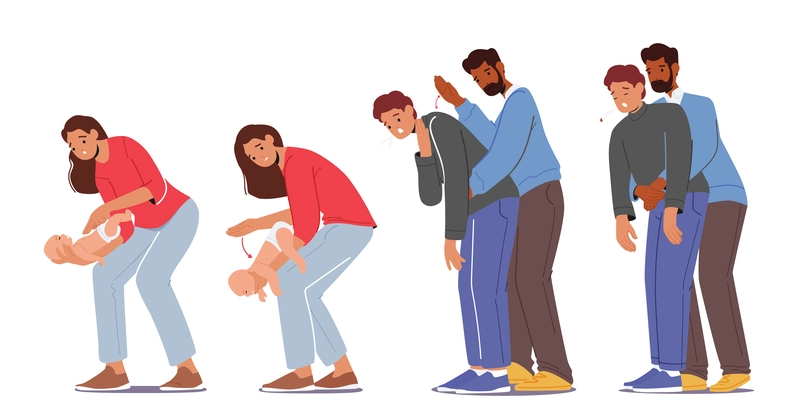
Heimlich Maneuver in Conscious Persons 1
- The patient can be in a standing or sitting position.
- Stand next to or behind the patient.
- Support his chest with one hand and make him lean forward.
- Hit the back (between the shoulder blades) 5 times quickly with the heel of the other hand in a sweeping manner.
Heimlich Maneuver in Conscious Persons 2
- It is checked whether the blockage is opened, and if it is, the process is stopped.
- If the blockage is not cleared, the Heimlich Maneuver is performed.
- The patient’s body is grasped by hugging him from behind.
- The thumb of one hand is placed on the upper part of the stomach, under the breastbone, making a fist. The hand that was made into a fist is grasped with the other hand.
Heimlich Maneuver in Conscious Persons 3
- It is pressed backwards and upwards with force.
- This movement is repeated 5-7 times until the foreign body comes out.
- If the blockage is not cleared, the back is struck again.
- These operations are repeated alternately, 5 times.
Heimlich Maneuver in Conscious Persons 4
- If the patient loses consciousness, he is laid on the hard surface.
- Pulse and respiration are evaluated from the jugular vein.
- Medical help is requested (112).
- Basic life support is applied.
Heimlich Maneuver in Unconscious Persons 1
- The patient is laid on the ground and his back is tapped 5 times in the side position.
- If the blockage is not removed, the patient is placed on a flat surface with his head turned to the side.
- Sit astride the patient’s legs.
- The heel of one hand is placed between the navel and the breastbone, and the other hand is placed on it.
Heimlich Maneuver in Unconscious Persons 2
- Oblique pressure is applied from the navel towards the shoulder blades.
- Pulse and respiration are evaluated from the jugular vein.
- The process continues until the foreign body is removed.
- Medical help is requested (112).
- This movement is continued 5-7 times until the foreign object comes out or until help arrives.
Heimlich Maneuver in Unconscious Persons 3
In such cases, when airway obstruction is suspected, first aiders will perform Basic Life Support.
If air does not escape after rescue breathing is given, it is thought that there is an obstruction. The first aider should check whether there is a foreign object in the mouth, and if he sees a foreign object, remove it.
Opening a Completely Obstructed Airway in Babies
- The baby is laid upside down on one arm of the first aider.
- With the help of the thumb and other fingers, the baby’s chin is grasped, held by the neck, and leaned forward in a prone position,
- The head is kept tense and in a position lower than the body,
- Gently tap the baby’s back between the shoulder blades with the inside of the wrist 5 times,
- He is turned on his back by grasping his head with his hand on the other arm,
- It is checked whether the foreign body comes out or not,
- If it does not come out, it is kept on its back with its head lower than its body,
- Pressure is applied from the lower part of the breastbone to the upper part of the abdomen with two fingers 5 times,
- It continues until the foreign body is removed,
- Medical help is requested (112).
Common Questions on Respiratory Obstruction
What is respiratory obstruction and why is it dangerous?
Respiratory obstruction is any narrowing or blockage in the airway that prevents air from entering or leaving the lungs. It is considered a medical emergency because it restricts the body’s intake of oxygen ($O_2$) and the removal of carbon dioxide ($CO_2$).
If the obstruction is complete, it can lead to respiratory arrest and permanent brain damage within minutes due to hypoxia (lack of oxygen in tissues).
What are the most common causes of an obstructed airway?
Causes can be categorized by how quickly they occur:
- Acute Causes: Choking on food or foreign objects, severe allergic reactions (anaphylaxis) causing throat swelling, or trauma to the neck.
- Chronic Causes: Chronic Obstructive Pulmonary Disease (COPD), asthma, tumors, or long-term inflammation of the bronchial tubes.
- Infectious Causes: Severe cases of epiglottitis or croup (common in children).
How do you identify the signs of a respiratory obstruction?
Clinical signs vary depending on the location of the blockage. Key symptoms to watch for include:
- Stridor: A high-pitched, whistling sound heard when breathing in.
- Retractions: The skin pulling in around the collarbone or ribs during breathing attempts.
- Cyanosis: A bluish or grayish tint to the lips, skin, or fingernails.
- Agitation and Panic: Gasping for air or clutching the throat (the universal choking sign).
What is the difference between partial and complete obstruction?
It is crucial to distinguish between these two for proper first aid:
Partial Obstruction: The person can still cough, speak, or make some noise. In this situation, you should encourage them to cough forcefully to clear the blockage themselves.
Complete Obstruction: The person cannot breathe, cough, or speak at all. They may turn blue quickly. This requires immediate intervention like the Heimlich maneuver or emergency medical services (EMS).
How is a respiratory obstruction treated by medical professionals?
Doctors use various advanced techniques to restore airflow:
- Intubation: Passing a tube through the mouth into the trachea.
- Bronchoscopy: Using a camera-equipped tool to locate and remove foreign objects.
- Cricothyrotomy: An emergency surgical procedure to create an airway through the neck when the upper airway is totally blocked.
- Medication: Bronchodilators for asthma or epinephrine for allergic reactions.