What is a Hearing Test (Audiometry) and an Audiogram?
What is Audiometry?
Hearing Test (Audiometry) is a medical assessment method designed to assess hearing ability and detect potential hearing impairments. It is used to identify the type of hearing loss a patient may be experiencing, measure its severity, and classify it.
This process plays a vital role in maintaining auditory health, diagnosing hearing-related disorders, and determining appropriate treatment or rehabilitation strategies. Audiometry tests are typically performed by trained professionals in specialized soundproof rooms.
These tests measure the softest sounds a person can hear, their hearing threshold, at various frequencies and intensity levels. By assessing sensitivity to different tones, the test provides valuable information about a person’s hearing function.
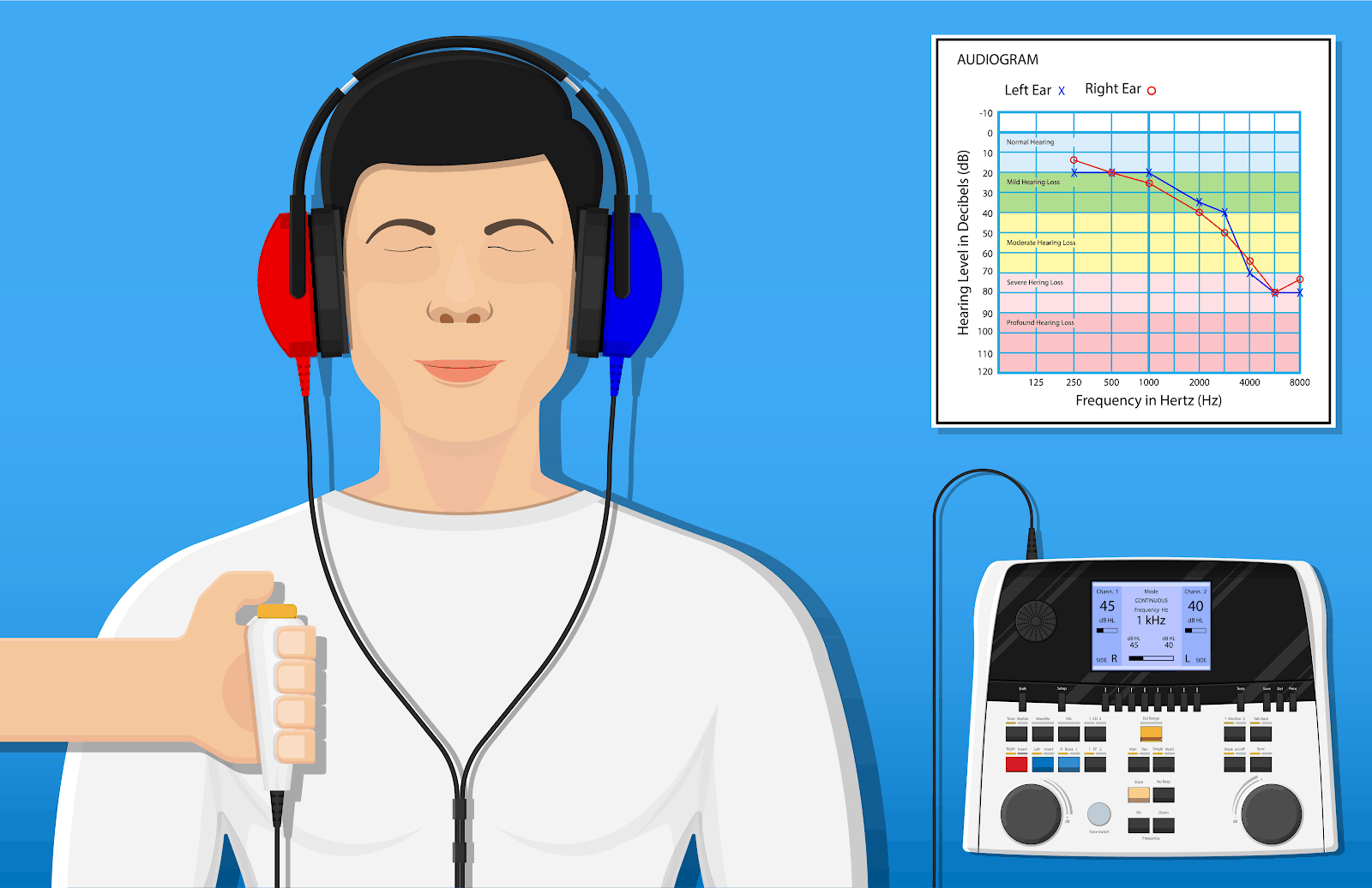
During the test, the patient is fitted with ear-like devices that play tones at different frequencies and volumes. The patient’s responses to these sounds are recorded to analyze their hearing abilities.
Audiometry evaluations are particularly important in the diagnosis and treatment of hearing loss, ear infections, or other auditory disorders. The procedure is usually performed by an audiologist or ear, nose, and throat (ENT) specialist.
Patients listen to sounds of varying pitches and intensities, and their responses help determine their hearing thresholds. This assessment helps assess overall hearing health and guides decisions about further intervention or treatment.
Audiometry tests are completely safe and non-invasive. However, it is crucial that they are performed by qualified professionals to obtain accurate results. These examinations are typically performed in ENT hospital departments, specialized clinics, or specialized hearing care centers.
Why is an Audiometry Test Performed?
An audiometry test is a comprehensive hearing measurement test designed to assess an individual’s hearing ability, detect potential hearing loss, and determine the degree of loss. The test analyzes hearing sensitivity by analyzing responses to sounds of different frequencies and intensities. This test can determine the type of hearing loss, the frequency at which it occurs, and its impact on daily life. It is an important diagnostic tool, particularly for individuals with suspected hearing loss, those experiencing tinnitus, or those experiencing hearing-related symptoms such as dizziness.
The reasons for performing an audiometry test are as follows:
- Determine the presence and degree of hearing loss.
- Evaluate complaints of ringing in the ears (tinnitus).
- Distinguish the type of hearing loss (conductive, sensorineural, or mixed).
- Check hearing status after ear infections.
- Aid in the diagnosis of inner ear disorders such as Meniere’s disease.
- Investigate complaints of dizziness (vertigo).
- Evaluate occupational hearing loss in individuals exposed to noise.
- Determine the need for hearing aids or cochlear implants.
- Check hearing function after trauma or head injuries.
- Monitor hearing development in children and assess speech delay.
How Many Types of Hearing Tests Are There?
Various hearing tests are utilized to identify the cause, type, and severity of hearing loss. These tests are tailored to assess specific parts of the ear and are selected by the doctor according to the patient’s individual condition.
-
Pure Tone Audiometry (PTA):
This test measures how well the ears can hear sounds at different frequencies. During the test, the patient is fitted with headphones.
Sounds are delivered at specific frequencies (for example, between 250 Hz and 8000 Hz).
The patient presses a button when they hear the sound.
Or they respond by raising their hand.
Pure-tone audiometry is one of the most commonly used tests to determine hearing threshold levels.
-
Speech Audiometry:
This assessment evaluates an individual’s ability to hear and comprehend speech sounds. Words or sentences are presented to the patient, who is then asked to repeat them. The test helps determine the impact of hearing loss on speech perception and is especially valuable in determining the appropriateness of hearing aids.
-
Tympanometry (Middle Ear Pressure Test):
Tympanometry is a diagnostic procedure designed to assess the movement of the eardrum and gauge the pressure within the middle ear.
The test involves introducing a low-frequency sound into the ear and measuring how the eardrum responds.
It helps identify issues like fluid buildup in the middle ear, eardrum perforations, or blockages in the Eustachian tube.
-
Auditory Brainstem Response Test (ABR):
This test evaluates the brainstem’s reaction to auditory signals and is especially useful for identifying hearing loss in infants or individuals unable to communicate. In some cases, the patient might receive mild sedation. As particular sounds are transmitted through headphones, specialized electrodes monitor changes in brain wave activity. The BERA test plays a vital role in diagnosing issues related to the inner ear and auditory nerves.
-
Otoacoustic Emission Test (OAE):
The otoacoustic emission test assesses how well the hair cells in the inner ear are functioning. During the test, a small probe is placed in the ear canal, and low-level sound waves are introduced into the ear. It is commonly used for newborn hearing screenings to help identify potential hearing loss.
-
Stapes Reflex Test (Acoustic Reflex Test):
This test evaluates the reaction of the middle ear muscles to loud noises. By transmitting sounds at specific levels into the ear, the response of the stapes muscle within the inner ear is assessed. It aids in identifying the nature of hearing loss and diagnosing nerve-related auditory issues.
Different tests target various aspects of hearing loss, and the doctor selects the most suitable procedure based on the specific hearing concern. Regular hearing assessments are essential for maintaining auditory health, allowing for early detection and management of potential hearing impairments.
What are The Different Levels of Hearing Test (Audiometry)?
Hearing loss is categorized into different degrees based on the lowest sound level a person can hear (hearing threshold). Hearing loss is classified as mild, moderate, severe, and profound. These degrees are determined by an audiometry test and are usually measured in decibels (dB).
Normal Hearing (0-25 dB):
Can hear whispers, soft natural sounds, and normal conversations with ease. No hearing loss is present.
Mild Hearing Loss (26-40 dB):
Has difficulty hearing soft sounds. May have difficulty understanding speech in environments with whispers and background noise.
Moderate Hearing Loss (41-55 dB):
Cannot hear normal speech clearly. Can hear people speaking loudly, but may miss some words.
Moderate-to-Severe Hearing Loss (56-70 dB):
Can hear only loud sounds. Has significant difficulty understanding speech.
Profound Hearing Loss (71-90 dB):
Can only perceive very loud sounds (e.g., engine noise, screaming). Hearing and understanding speech is nearly impossible.
Profound Hearing Loss (+91 dB and above):
Hearing is completely lost or only very loud sounds can be perceived. Advanced hearing solutions such as a cochlear implant may be necessary.
Who Should Get an Audiometry (Hearing Test)?
Audiometry (hearing test) can be performed on a wide range of age groups and health conditions to evaluate hearing-related problems.
Here are some examples of who can benefit from an audiometry test:
Individuals with Hearing Problems:
Individuals with hearing loss, ear congestion, or exposure to loud noises can have their hearing assessed through an audiometry test. Such symptoms require professional help.
Children:
Children’s hearing health is critical to their developmental processes. Screening for congenital hearing loss in infants is crucial for early intervention. Audiometry is also performed to identify any hearing problems that may affect children’s speech and language development.
Elderly Individuals:
The risk of hearing loss increases with aging. Therefore, it is recommended that individuals aged 60 and over undergo regular audiometry tests. Hearing loss in older individuals can affect social interaction and quality of life, so early diagnosis is crucial.
Individuals Working with Sound:
Musicians, teachers, and other professionals who work with sound can experience hearing problems due to high noise exposure. Therefore, individuals in this group should regularly monitor their hearing health by having an audiometry test.
Those with Ear Infections or Trauma:
Individuals who have had ear infections, trauma, or surgery may also be referred for an audiometry test to assess their hearing levels. This test is important for identifying possible causes of hearing loss.
Individuals with a Genetic Predisposition:
Individuals with a family history of hearing loss may require an audiometry test due to genetic predisposition. Regular audiometry testing is recommended for early diagnosis, treatment, and support.
Audiometry testing is an important step in maintaining and improving hearing health. Early diagnosis of hearing problems for individuals of all ages is crucial for determining appropriate treatment methods. Therefore, it is recommended to consult a specialist if you experience any symptoms or concerns regarding your hearing.
How is an Audiometry Test Performed?
An audiometry test consists of a series of tests used to evaluate hearing. These tests are performed to determine the degree and type of hearing loss.
Here is a general step-by-step guide on how to perform an audiometry test:
-
Preparation:
Interview:
Before the test, the audiologist or hearing specialist will inquire about the individual’s hearing complaints, medical history, and any previous hearing tests.
Ear Examination:
The ears are examined with an otoscope to ensure the ear canals are clear and free.
-
Pure Tone Audiometry:
Plug-in Headphones:
Headphones are placed on the patient. These headphones are used to deliver sounds to each ear separately.
Presenting Sounds:
Pure tones of different frequencies (high and low tones) are delivered. The intensity of the sound is gradually increased at each frequency.
Responding:
The individual is asked to indicate each sound they hear by pressing a button or raising their hand. This process is repeated for each ear, separately.
Recording the Results:
The hearing threshold, the lowest sound level a person can hear, is recorded on a graph called an audiogram.
-
Speech Audiometry:
Playing Words and Sentences:
The individual is told specific words or sentences. These words are repeated at different volume levels.
Responding:
The individual is asked to repeat the words or sentences they hear. This measures how well the individual can understand speech.
-
Tympanometry:
Inserting the Probe:
A small probe is inserted into the ear canal.
Pressure Changes:
The probe measures the response of the eardrum by changing the pressure in the ear canal.
Results Evaluation:
This test evaluates middle ear function and the mobility of the eardrum.
-
Acoustic Reflex Test:
Loud Sound Exposure:
The individual is exposed to short, loud sounds.
Muscle Response Measurement:
How the ear muscles respond to these sounds is measured. This is used to evaluate the functioning of the inner ear, auditory nerve, and brainstem.
-
Results Analysis:
Evaluation:
Test results are analyzed, and the type and degree of hearing loss (conductive, sensorineural, or mixed) are determined.
Counseling:
The audiologist provides information about appropriate treatment options based on the test results. This may include hearing aids, medical treatment, or surgical interventions.
What is an Audiogram?
An audiogram is a graphical map of hearing levels obtained from an audiometric test. In short, an audiogram is a visual representation of a hearing test. This graph shows a person’s hearing level in both ears at different frequencies (tones). An audiogram visualizes the results of audiometric tests in a more easily interpretable way.
How to Read an Audiogram?
The main elements of an audiogram:
Horizontal axis (X): Frequency (Hz)
- 125 – 250 – 500 – 1000 – 2000 – 4000 – 8000 Hz
- Low frequencies → low-pitched sounds
- High frequencies → high-pitched sounds (e.g., “s,” “ş,” “f”)
Vertical axis (Y): Hearing threshold (dB)
- Good hearing upwards
- Poor hearing downwards
What are Frequency and Decibels?
Hearing is based on two basic factors:
Frequency (Hz):
Determines whether a sound is high or low. Low frequencies represent bass sounds, while high frequencies represent high notes (like piano notes).
Decibel (dB):
Indicates how loud a sound is. 0–20 dB is considered very soft, while 110 dB is considered uncomfortably loud.
For most people, hearing loss begins by affecting the higher frequencies first. This can make it difficult to hear some speech sounds, soft sounds in nature, or details in music.
What Do the Audiogram Symbols Mean?
Most speech sounds are located in an area known as the “speech banana.” This is the curve on the audiogram that encompasses the sounds that help us understand speech.
The following symbols are used on the audiogram:
Red Circle (O):
Hearing level of the right ear.
Blue Cross (X):
Hearing level of the left ear.
Red Line:
Shows the hearing profile in the right ear.
Blue Line:
Shows the hearing profile in the left ear.
The area above the lines:
Represents sounds the person cannot hear.
How to Identify the Type of Hearing Loss Based on Audiometry Results?
-
Poor Air Conduction – Normal Bone Conduction = Conductive Loss
Example:
Air conduction 50 dB, bone conduction 10 dB
This is the loss that responds best to treatment.
Possible Causes:
- Earwax
- Otitis media
- Middle ear fluid
- Eardrum perforation
- Otosclerosis
-
Air conduction = Bone conduction = Loss → Sensorineural loss
Example:
Air conduction 60 dB, bone conduction 58 dB
Usually permanent.
Possible Causes:
- Age-related loss
- Noise
- Genetics
- Sudden hearing loss
- Medications (ototoxic)
-
Both Air And Bone Are Damaged, But There İs A Difference → Mixed Loss
Example:
Air 70 dB, bone 40 dB
Both conductive and neural problems are present.
What is an Audiogram Used For?
The audiogram test is one of the most important tools used by specialists to determine the level and type of hearing loss. Audiograms are also used to monitor the progress of patients with existing hearing loss.
Information about the three main types of hearing loss that can be detected through an audiogram is listed below:
Conductive Hearing Loss:
Conductive hearing loss is hearing loss caused by problems in the outer ear or middle ear. This type of hearing loss occurs due to factors that prevent sound from reaching the outer ear or middle ear.
Causes:
- Earwax,
- Obstructions caused by an object in the ear canal,
- Perforated eardrum,
- Conditions such as middle ear infections,
Among the main causes of this type of hearing loss are conductive hearing loss.
Conductive hearing loss is a type of hearing loss that can usually be treated or corrected with surgery.
This type of hearing loss can be seen on an audiogram as the inability to hear high-frequency sounds at low decibel levels.
Sensorineural Hearing Loss:
Sensorineural hearing loss is a hearing loss that results from problems in the inner ear or nerves and necessitates an audiogram.
Causes:
- It can occur due to factors such as aging,
- Perforation of the eardrum,
- And ear infections. Sensorineural hearing loss is usually permanent and cannot be treated.
The impact of hearing loss can be mitigated through the use of devices like hearing aids or cochlear implants. Noise-induced hearing loss is commonly categorized within this group as well.
Analyzing the audiograms of individuals with this type of hearing loss reveals difficulty in perceiving low-frequency sounds, even at higher decibel level.
Mixed Hearing Loss:
Mixed hearing loss is a combination of both sensorineural and conductive hearing loss.
Causes:
This type of hearing loss can be caused by problems in the inner ear, outer ear, or middle ear, along with problems in the hearing loss.
When the audiogram of patients with mixed hearing loss is examined, it is seen that they cannot hear both low- and high-frequency sounds at low decibel levels.
Who Should Use an Audiogram?
It begins with screening tests for newborns.
- Individuals with hearing difficulties,
- Those experiencing tinnitus,
- Older adults,
- Individuals with a family history of hearing loss,
- Industrial workers (those exposed to noise),
Differences Between Audiometry and an Audiogram
Audiometry is a testing process; it is a procedure or test performed to measure a person’s hearing levels.
An audiogram is the result of this test; it is a graph that visually represents hearing levels.
In short, the results of an audiometry test are presented as an audiogram. An audiogram is a visual report of an audiometry test.